


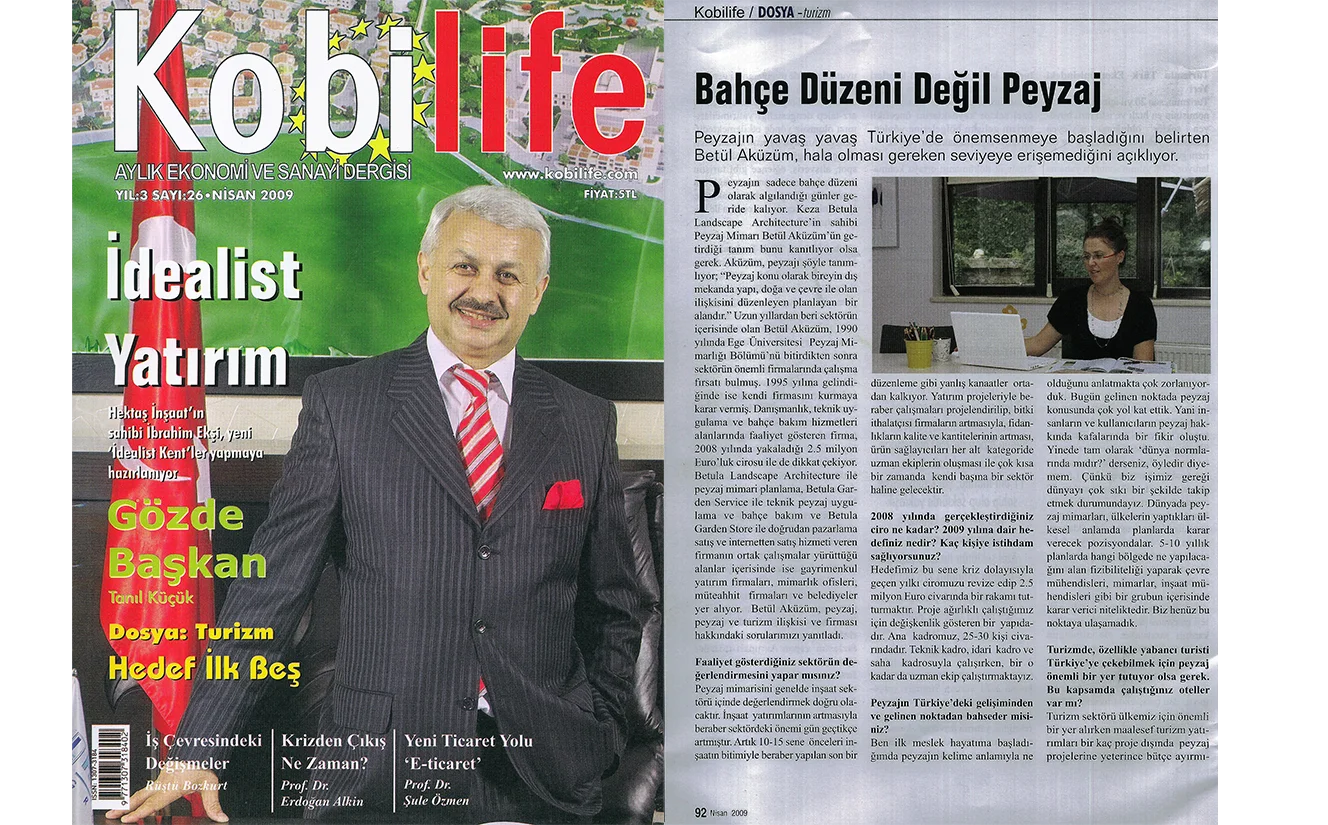
More Than Garden Design: Landscape Architecture
Betül Aküzüm notes that landscape architecture is gradually gaining recognition in Türkiye, although she believes the profession has yet to reach the level it should.
The days when landscape architecture was perceived merely as garden design are gradually becoming a thing of the past. The definition offered by Betül Aküzüm, Landscape Architect and founder of Betula Landscape Architecture, is perhaps evidence of this shift. Aküzüm defines landscape architecture as follows:
“Landscape architecture is a field that plans and organizes the relationship of individuals with buildings, nature, and the environment in outdoor spaces.”
Having worked in the sector for many years, Betül Aküzüm graduated from the Department of Landscape Architecture at Ege University in 1990 and subsequently had the opportunity to work with some of the leading firms in the industry. In 1995, she decided to establish her own company.
Operating in the fields of consultancy, technical implementation, and garden maintenance, the company attracted attention with a turnover of €2.5 million in 2008. Today, the group provides landscape architectural planning through Betula Landscape Architecture; technical landscape implementation and garden maintenance services through Betula Garden Service; and direct marketing, retail, and online sales through Betula Garden Store.
The company collaborates with a wide range of clients and partners, including real estate investment companies, architectural practices, construction and contracting firms, and municipalities. Betül Aküzüm answered our questions about the relationship between landscape architecture and tourism, as well as the development and activities of her company.
How would you evaluate the sector in which you operate?
It would be fair to consider landscape architecture primarily within the construction sector. As construction investment has increased, the importance of landscape architecture within the industry has grown steadily.
The misconception that landscape design is simply a final touch carried out after construction has gradually begun to disappear. Landscape work is now increasingly integrated into investment projects from the outset. With the completion of projects, the growth in the number of plant-importing companies, improvements in the quality and capacity of nurseries, and the emergence of specialized teams among product suppliers across different subcategories, landscape architecture will become a fully established sector in its own right in a relatively short period of time.
What was your turnover in 2008, what is your target for 2009, and how many people do you employ?
Due to the economic crisis, our target this year is to revise last year’s turnover and achieve a figure of approximately €2.5 million.
Because we primarily work on a project basis, our business structure is variable. Our core team consists of approximately 25–30 people. In addition to our technical, administrative, and field teams, we also employ an equal number of specialist personnel.
Could you tell us about the development of landscape architecture in Türkiye and where the profession stands today?
When I first began my professional career, it was very difficult to explain even what the word “landscape” meant. Today, however, we have made considerable progress. People and end users have developed a much clearer understanding of landscape architecture.
Nevertheless, if you ask whether we have reached “international standards,” I would not say that we have. Because of the nature of our work, we have to follow developments around the world very closely.
In many countries, landscape architects have a role in making decisions as part of national and regional planning processes. They contribute to long-term plans by conducting site and area feasibility studies and participate in decision-making alongside environmental engineers, architects, civil engineers, and other professionals, determining what should be developed in particular areas over five- or ten-year periods.
We have not yet reached that level in Türkiye.
Landscape architecture must play an important role in tourism, particularly in attracting international visitors to Türkiye. Do you work with any hotels in this context?
Although tourism is an important sector for our country, unfortunately, tourism investors do not allocate sufficient budgets to environmental and landscape projects. Green spaces within a facility, which can serve as important activity and recreational areas, are often not utilized to their full potential.
In addition to the hotels we work with, recent developments have increasingly been shaped by foreign buyers—particularly British and German nationals—purchasing property directly in Türkiye. There are numerous investment projects, especially along our sunny coastal regions, aimed at the international property market.
Do you think landscape architecture is given sufficient importance in Türkiye from a tourism perspective?
No. With the exception of a few projects, I cannot say that landscape investment exceeds 5–6 percent of the overall construction investment cost.
When compared with international standards, the appropriate proportion should be somewhere between 15 and 25 percent.
What can landscape architecture contribute to tourism?
Golf courses, water parks, and sports facilities should be properly planned and marketed. Zoos, entertainment centers, holiday resorts, tourism accommodation facilities, parks, transportation corridors, historic sites, and cities should all be reassessed from this perspective. Their plans and budgets should be prepared, and implementation should begin as soon as possible.
Landscape architecture is a field that plans and organizes the relationship between individuals, buildings, nature, and the environment in outdoor spaces.
When we think of tourism, we generally associate it first with hotel-based tourism centered on holidays and accommodation. However, by enriching this experience and supporting it with the activities and destinations mentioned above, we can offer both domestic and international visitors a broader range of alternative tourism experiences.
Could you tell us about some of the projects you completed in 2008?
Emaar Turkey, Toskana Vadisi, Kalkan Lavanta, Topkapı Merkez Evleri, and Gebze Tatlıkuyu Valley are among the corporate projects that immediately come to mind.
In addition, we have undertaken landscape applications for Beykoz Konakları, AcarKent, and Kemer Country Kütük Evler, as well as a number of villa and residential projects.
Could you tell us about your ongoing projects?
Emaar Turkey and Kalkan Lavanta are currently among our ongoing corporate projects. We also have several projects currently underway in Romania.
Is there anything in particular you would like to emphasize?
Landscape investment planning is extremely important. Because landscape architecture combines functional and aesthetic design solutions that can reduce construction costs while enhancing the value and quality of a development, I believe that projects in which investors and construction companies give this discipline the attention and sensitivity it deserves are far more likely to succeed.
In my view, the essential first step is to embark on a project with a team of landscape architects who are specialists in their respective fields, whether they are based in Türkiye or abroad.
— Betül Aküzüm


