


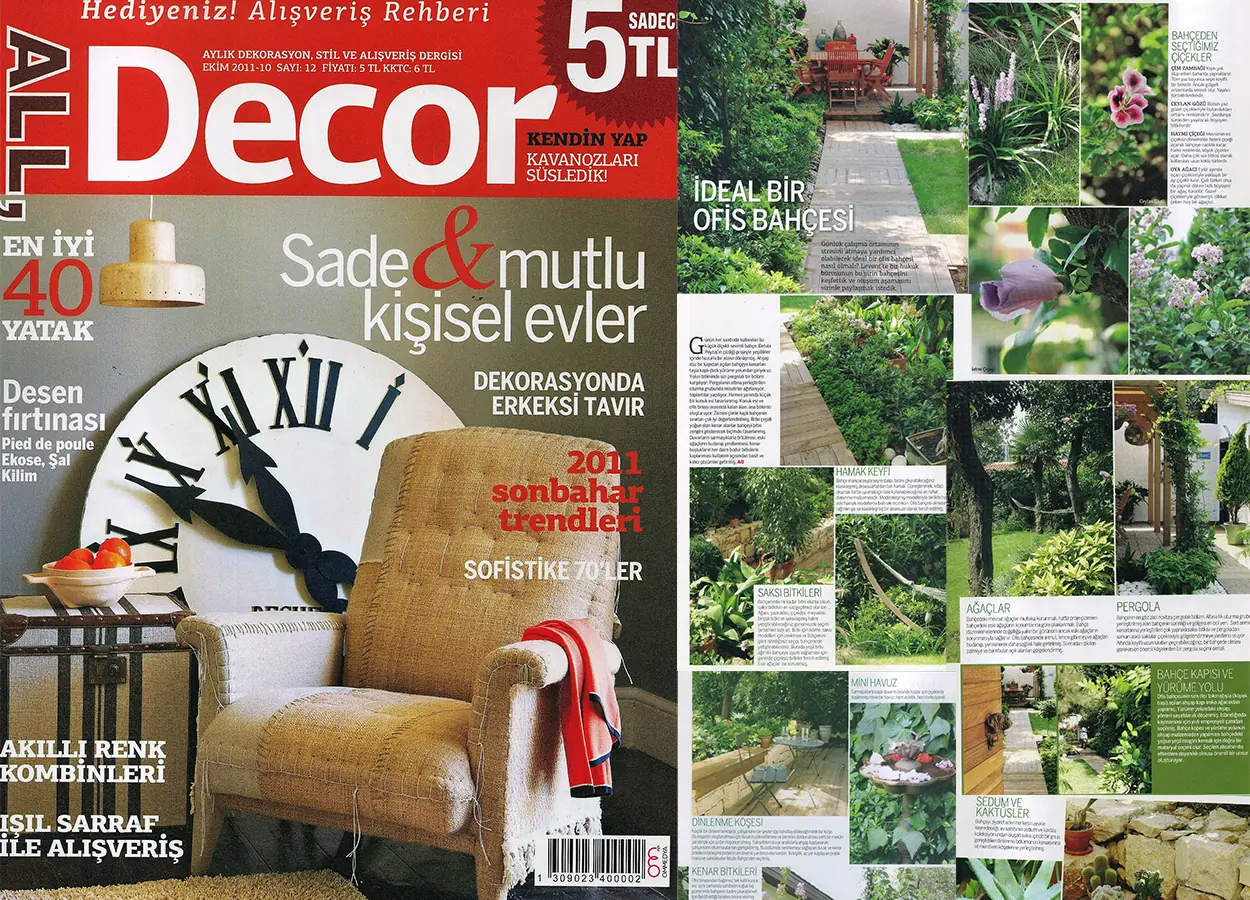
An Ideal Office Garden
What should an ideal office garden look like—one that helps relieve the stress of the everyday working environment? We discovered this charming little garden belonging to a law firm in Levent and wanted to share the story of how it was created with you.
Used throughout the day, this small and inviting garden has been transformed into a peaceful green retreat through a landscape design by Betula Peyzaj. The garden is entered through a simple wooden gate, leading onto a decked pathway edged with stone. At the end of the path, a pergola-covered area welcomes visitors.
The seating arrangement beneath the pergola provides a comfortable setting for hosting guests and holding informal meetings. A small guest house has also been designed immediately adjacent to it. The space between the guest house and the office building forms the garden’s main area.
The boundaries of the lawn-covered garden have been used very effectively. Planting beds along the edges, featuring a rich variety of species, have been designed to create an abundant and lush appearance. Covering the walls with climbing plants, pruning and rejuvenating mature trees, and consistently filling the peripheral spaces with low-growing plants have provided simple, practical, and long-lasting solutions.
Enjoying the Hammock
With its view of the garden, the hammock is one of those timeless garden accessories that invites you to simply sit back and enjoy the surroundings. It is one of the most comfortable ways to relax, whether for sunbathing, reading a book, or even taking a nap.
Alongside contemporary designs, traditional hammock styles are still widely available. Despite being located in an office garden, the hammock was chosen as an elegant and classic accessory that complements the character of the space.
Container Plants
No matter how much planting a garden contains, container plants remain among its most indispensable elements. Trees, foliage plants, flowering species, fruit-bearing plants—today, countless varieties can be successfully grown in containers.
The choice is ultimately yours: select plants according to the local climate, and choose containers according to your taste and budget. In this garden, foliage plants without prominent flowers have generally been preferred to complement the predominantly green planting scheme. The mature existing trees have also been preserved.
Trees
Existing trees should always be preserved wherever possible; ideally, the garden design should be developed around the location of mature trees already present on the site. A naturalistic character in garden design can only truly be achieved when existing mature trees are retained.
In this office garden, fruit trees such as pear and lemon have been pruned and rejuvenated, improving their overall health. Palms and bamboo planted later have been used to provide shade in the more open areas.
Pergola
The pergola area is undoubtedly the most eye-catching part of the garden. Furnished with teak seating, it occupies the coolest and most shaded area of the garden.
Large-leaved container plants positioned along the edges of the hardscape, together with hanging planters suspended from the pergola, contribute additional greenery, shade, and seasonal color.
A pergola is one of the most valuable features a garden can offer—a place where you can spend long, pleasant hours in the shade and enjoy the outdoors.
Garden Gate and Pathway
The wooden entrance gate, opened by the office garden’s distinctive dog-head door knocker, is made of iroko wood. The timber decking along the pathway has been laid in an irregular, staggered pattern to create a more dynamic appearance.
Grooved, pressure-treated pine was selected for the walking surface to reduce the risk of slipping when wet. Using timber for both the garden gate and pathway was an effective material choice for breaking up the dominant green palette of the garden.
Durability against outdoor conditions was an important consideration in selecting the timber.
A Relaxation Corner
A small relaxation corner provides employees with an intimate place to have a drink and unwind during the day.
Raising the existing wall and filling the ground level created an opportunity to establish an entirely new space. Sections of the raised wall were clad with timber at intervals, extending and defining additional seating areas for employees.
The combination of the raised wall and edge planting, which helps create a cooler and more sheltered microclimate, is one of the project’s most important supporting elements.
Compact, practical tables and chairs designed for two people were selected from Mudo Bahçe, making efficient use of the limited space.
Mini Pond
A small ornamental pond decorated with flowers has been positioned in front of the ivy-covered wall, creating an element that is both aesthetically pleasing and functional, particularly as a source of water for birds.
Edge Planting
In front of the single-storey guest house, which stands independently from the main office building, a carefully selected planting scheme frames the building while also enhancing the owner’s enjoyment of the garden during the cold winter months.
The combination of the pink-flowering crape myrtle, evergreen arborvitae, and lavender planting in the foreground creates a striking and harmonious garden composition.
Sedum and Cacti
A collection of potted succulents, consisting of sedum and cacti from the owner’s personal collection, has been placed along the edges of the expanded relaxation area and at the corners of the steps.
These plants provide an attractive display that garden visitors can enjoy while adding texture and character to otherwise overlooked spaces.
Aloe Vera
With pale green, sword-shaped leaves edged with small spines, Aloe vera has a distinctive architectural form. Its fleshy leaves emerge from a compact base and, when broken, release a gel-like plant extract.
The translucent inner portion of the leaf is known as Aloe vera gel. Its use in the cosmetics and health industries has increased considerably in recent years.
Cactus
A low-water-use desert plant that has inspired many enthusiasts to become collectors. Cacti generally thrive in well-drained, mineral-rich soils and require relatively little irrigation.
Sedum
Commonly known in Turkish as dam koruğu, sedum species are succulents characterized by their fleshy leaves, often arranged in rosettes, with layered forms and a waxy surface.
They are well adapted to areas with low humidity and can thrive without significant damage or stress under dry conditions. Approximately 35 species are found in Türkiye.
Flowers Selected from the Garden
Liriope
Liriope dies back during winter and begins producing new foliage in early spring. It remains an attractive foliage plant throughout the summer, although it performs best in shaded conditions. It is a spreading, ground-covering plant well suited to planting beneath trees and in shaded garden areas.
Geranium
Geraniums add vibrant color to the garden throughout the summer with their attractive flowers. These plants spread and develop freely, creating a lush flowering effect.
Hollyhock
Hollyhocks bring color and vitality to the garden during periods when relatively few other plants are in flower. They produce large blooms in a range of colors and are primarily cultivated as ornamental plants. Their long, deep root systems help them establish successfully in suitable conditions.
Crape Myrtle
Crape myrtle blooms in September and can remain in flower for approximately one month. Although some varieties develop as shrubs, it is primarily a deciduous, fast-growing tree.
With its abundant and attractive flowers, crape myrtle is a striking ornamental tree that immediately draws attention in the garden.


